Private LLM vs ChatGPT API: What Indian Businesses Need to Know
DPDP Act 2023, RBI data localization, and why sectors like BFSI and healthcare cannot send data to US AI APIs — plus the private deployment solution.
DPDP Act 2023, RBI data localization, and why sectors like BFSI and healthcare cannot send data to US AI APIs — plus the private deployment solution.
Every week, a new Indian company comes to us having already built an AI system on the OpenAI API — only to realize six months in that their legal team or board won't approve it.
The issue isn't the AI. The issue is where the data goes.
When you send a query to the OpenAI API, that data travels to OpenAI's servers in the United States. For most consumer apps, this is fine. For Indian businesses handling customer financial data, medical records, or legally privileged information, it's a significant compliance and legal risk.
This article explains the regulatory landscape, who is actually at risk, and what a private LLM deployment looks like in practice.
The Regulatory Landscape in India
DPDP Act 2023 (Digital Personal Data Protection Act)
India's new data protection law was enacted in August 2023. While the full enforcement rules are still being finalized, the law establishes clear principles:
- Personal data of Indian residents must be processed lawfully
- Cross-border data transfers are subject to central government approval for certain categories
- Significant data fiduciaries (large processors) face stricter localization requirements
- Penalties for violations: up to ₹250 crore per incident
If your AI system processes names, phone numbers, email addresses, financial information, health data, or any other personal data of Indian users — the DPDP Act applies to you.
Sending that data to a US-based API without proper data processing agreements and transfer mechanisms puts you in a grey zone that no serious compliance officer will approve.
RBI Data Localization (BFSI Sector)
The Reserve Bank of India's 2018 circular mandated that all payment system data be stored exclusively in India. In 2023, this was extended with additional guidance on cloud and third-party data processing for regulated entities.
For banks, NBFCs, payment companies, and insurance firms: customer financial data cannot be processed on foreign servers without explicit RBI approval. This definitively rules out the OpenAI API for any workflow touching financial records.
SEBI (Securities and Exchange Board of India)
SEBI's cybersecurity framework requires that data related to securities transactions, investor records, and client communications be stored on servers within India. Any AI system built for wealth management, stock broking, or investment advisory must comply.
Healthcare (DISHA — Digital Information Security in Healthcare Act)
While DISHA is still pending full parliamentary passage, existing MoHFW guidelines treat electronic health records as sensitive personal data requiring Indian residency. Hospitals and healthtech companies should treat this as a hard requirement now.
Who Is Actually at Risk?
High risk (should not use cloud AI APIs for production workflows):
- Banks and NBFCs
- Insurance companies
- Payment processors and fintech
- Stock brokers and wealth management firms
- Healthcare providers and healthtech
- Law firms handling client data
- Government contractors
Medium risk (should get legal sign-off):
- HR tech platforms processing employee data
- EdTech platforms with minor user data
- E-commerce companies with large customer databases
- Accounting software platforms
Lower risk (standard cloud AI APIs generally acceptable):
- B2B SaaS companies without sensitive personal data
- Content and marketing tools
- Internal productivity tools
What Is a Private LLM Deployment?
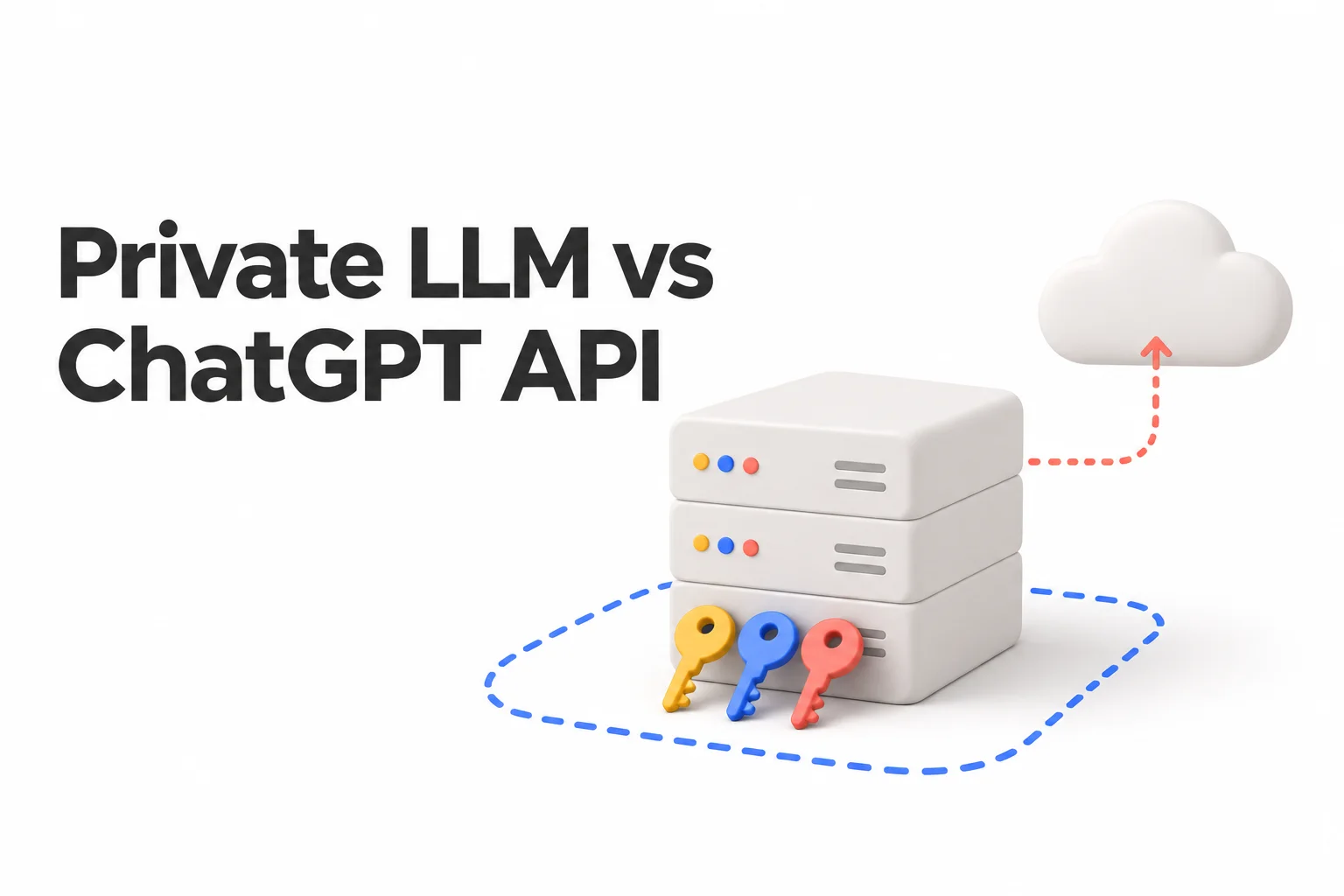
A private LLM deployment means running a large language model entirely within your own infrastructure — your servers, your cloud region, your control. No query, no document, no customer interaction leaves your environment.
The components:
Ollama — A tool that lets you run open-source LLMs (Mistral, LLaMA 3, Gemma, Phi-3) locally via a simple REST API. Think of it as a self-hosted OpenAI API.
Open-source models — Mistral 7B, LLaMA 3 8B, and Phi-3 Medium are the most commonly used. They perform at GPT-3.5 level on most business tasks. For specialized domains (legal, medical, finance), fine-tuned variants exist.
ChromaDB / Qdrant — Self-hosted vector databases for RAG (retrieval-augmented generation) — your AI chatbot's knowledge base.
FastAPI / Node.js — Your application layer that connects everything.
Deployment target — A VPS in an Indian data center (AWS ap-south-1 Mumbai, Azure India Central, Google Cloud Mumbai, or Indian providers like Yotta and NxtGen).
Architecture: Private LLM on Indian Infrastructure
User Query
    │
    ▼
Your Application (FastAPI)
    │
    ├── ChromaDB (vector search) ──── Your documents
    │         ↓ Retrieved context
    └── Ollama API (local LLM) ──── Mistral 7B / LLaMA 3
              ↓
    Response → User
ALL components run on your Mumbai VPS.
Nothing leaves India.
Setup in Practice
curl -fsSL https://ollama.ai/install.sh | sh
ollama pull mistral:7b-instruct-q4_K_M
ollama pull nomic-embed-text
curl http://localhost:11434/api/generate -d '{
  "model": "mistral:7b-instruct-q4_K_M",
  "prompt": "What is the RBI repo rate?",
  "stream": false
}'
The Ollama API is designed to be OpenAI-compatible. Most code written for the OpenAI API can switch to Ollama with one line change:
from openai import OpenAI
client = OpenAI(api_key="sk-...")
from openai import OpenAI
client = OpenAI(
    base_url="http://localhost:11434/v1",
    api_key="ollama"  # any string works
)
Performance: Is a Local Model Good Enough?
This is the most common concern. Will an open-source model running on my server be as good as GPT-4?
For most business tasks — customer support, document Q&A, form processing, email drafting, data extraction — Mistral 7B and LLaMA 3 8B perform at GPT-3.5 level, which is more than sufficient.
Where they fall short vs GPT-4:
- Complex multi-step reasoning
- Code generation for complex algorithms
- Creative writing tasks requiring nuance
- Tasks requiring world knowledge past their training cutoff
For a banking chatbot answering policy questions from a document store, GPT-3.5-level is excellent. You don't need GPT-4 to explain a fixed deposit maturity schedule.
Hardware requirements for running Mistral 7B:
- Minimum: 16GB RAM (CPU inference, ~2-3 tokens/sec)
- Recommended: 32GB RAM (faster CPU inference, ~5-8 tokens/sec)
- Optimal: GPU server with 8GB+ VRAM (20-40 tokens/sec)
For a customer-facing chatbot handling 100 concurrent users, we recommend a dedicated GPU instance (AWS g4dn.xlarge in Mumbai, ~$0.52/hour or ~₹1,300/day).
Cost Comparison: Private vs Cloud API
For a bank handling 10,000 customer queries per day:
| Approach | Monthly Cost | Data Location |
|---|---|---|
| OpenAI GPT-4o | ~₹1,20,000 | USA ❌ |
| OpenAI GPT-4o-mini | ~₹15,000 | USA ❌ |
| Private Mistral 7B (GPU VPS) | ~₹35,000 | Mumbai ✅ |
| Private Mistral 7B (CPU VPS) | ~₹8,000 | Mumbai ✅ |
For compliance-sensitive sectors, the private option is not only the legal choice — it's often the cheaper one at scale.
What We've Built for Indian BFSI Clients
We've deployed private LLM systems for:
- A cooperative bank in Gujarat: policy Q&A chatbot, all data on their on-premise server
- An insurance company in Mumbai: claims processing assistant, running on AWS Mumbai
- A CA firm in Ahmedabad: tax document analyzer, self-hosted on their office server
In all cases, the motivation was compliance first, cost second. The cost savings were a pleasant surprise.
The One Thing to Do This Week
If you're currently using the OpenAI API in production and handling Indian customer data, do this: forward this article to your legal or compliance team and ask them to review your data processing agreements.
You may be fully compliant — many companies are. But it's worth verifying before a regulator asks first.
We're Monk Media One Tech — AI automation agency, Ahmedabad, India with a branch in Ontario, Canada. We specialize in private LLM deployments for compliance-sensitive industries.
Book a free discovery call: monkmediaone.tech/contact 📞 +91 88668 19349 | hello@monkmediaone.tech