
What Is an AI Knowledge Base Chatbot?
How It Works, Simply Explained
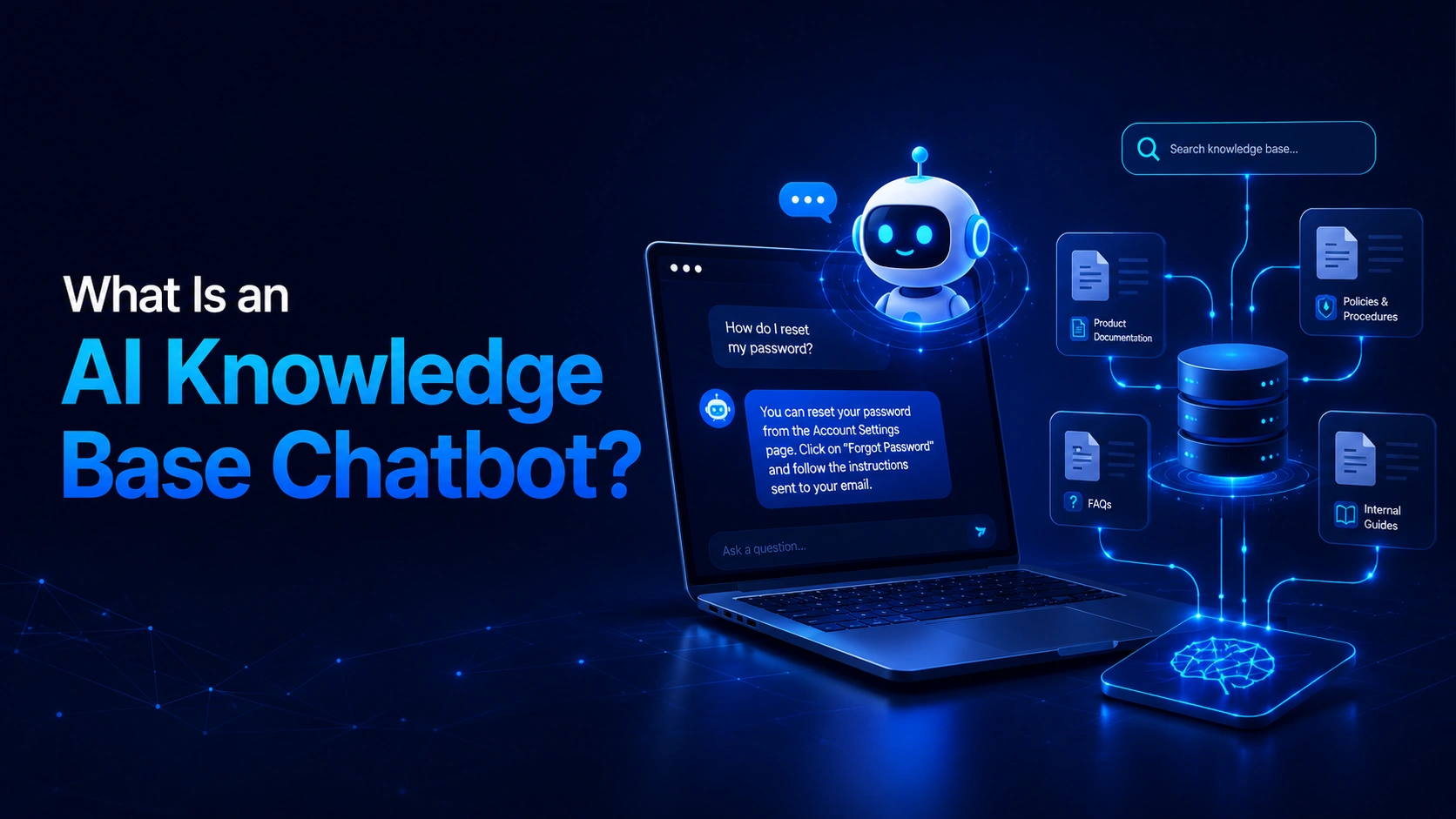
Your documents are broken into chunks and converted into “embeddings” – numerical representations stored in a vector database. When someone asks a question, the system finds the most relevant chunks of your documents and hands them to the LLM as context, so the answer is grounded in your actual content rather than the model’s general training data.
Internal vs. External Use Cases
| Use Case | Who Uses It | Example |
|---|---|---|
| Internal knowledge assistant | Employees | “What’s our refund policy for enterprise clients?” |
| Customer-facing support bot | Customers | “How do I reset my device to factory settings?” |
| Onboarding assistant | New hires | “How do I submit an expense report?” |
Why It Beats a Simple FAQ Page
- Answers in natural conversational language, not a static list a person has to scan
- Can combine information from multiple documents into a single coherent answer
- Updates automatically as source documents change – no manual FAQ rewriting
- Can cite the exact source document, building trust in the answer
Frequently Asked Questions
What happens if the chatbot doesn’t know the answer?
A well-built system is instructed to say it doesn’t have that information rather than guessing, and can route the question to a human for follow-up.
How often does the knowledge base need updating?
The retrieval index should be refreshed whenever source documents change – this can be automated so updates flow through without manual re-indexing.
Is this the same as RAG?
An AI knowledge base chatbot is essentially a RAG system with a chat interface built on top – RAG is the underlying technique that makes it work.