



What Is an AI Agent? A Non-Technical Guide for Business Owners
Every conference, every LinkedIn post, every news article is talking about AI agents. And most of the explanations assume you already know what a transformer is, what RAG means, and why LangChain matters.
You don't need to know any of that to understand what an AI agent can do for your business. This is the version for business owners.
The Simple Definition
An AI agent is a software system that can take a goal, figure out how to achieve it, and actually do the work — without a human guiding it step by step.
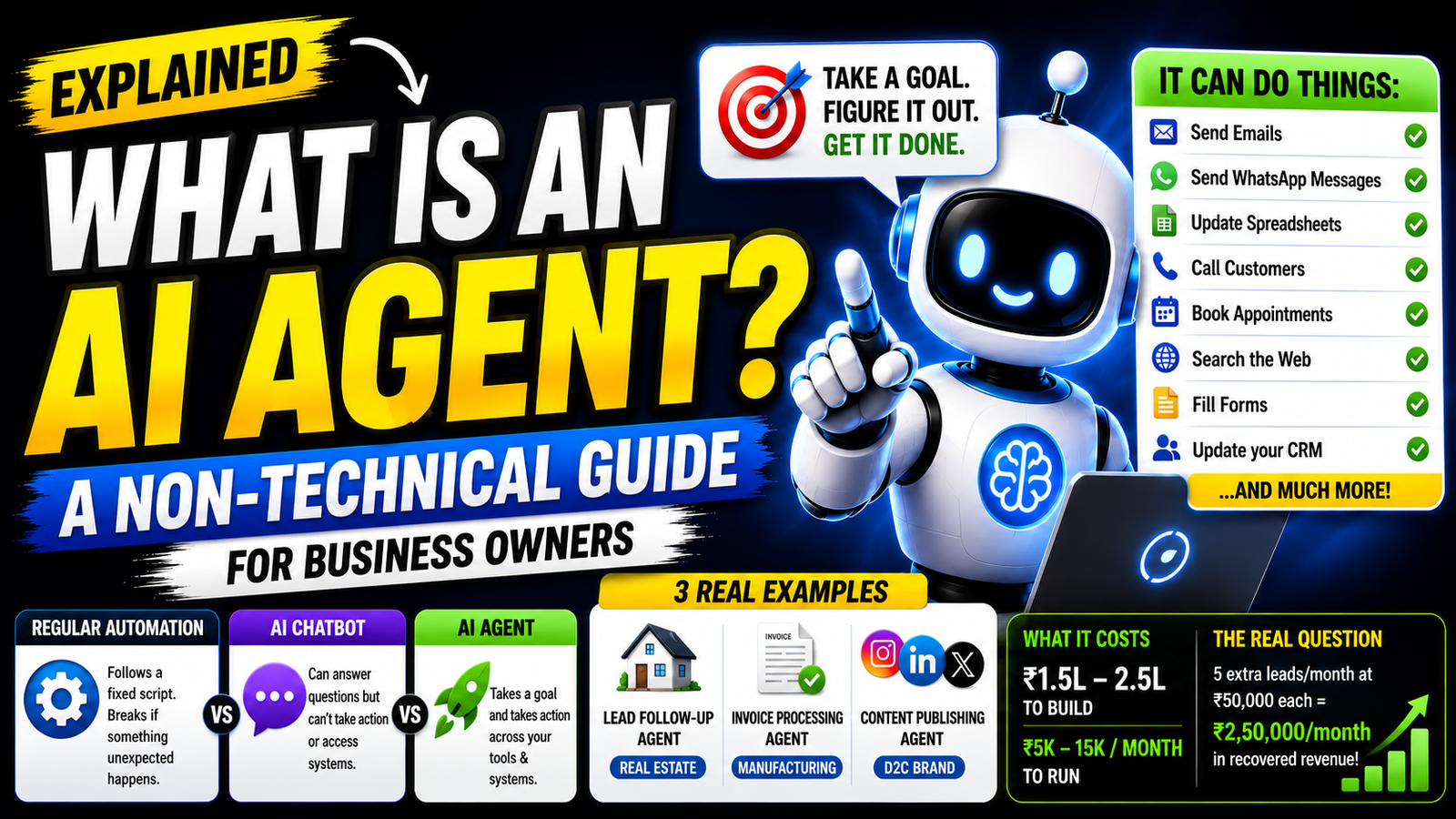
The key difference from a regular chatbot: it can take actions. Not just answer questions, but actually do things. Send emails. Update spreadsheets. Call customers. Book appointments. Search the web. Post on social media. Fill forms. Transfer money (with the right permissions). Update your CRM.
The Employee Analogy
Imagine you hire a new staff member. You give them a clear instruction and they figure out how to execute it. That's an AI agent.
A regular software automation is like giving someone a fixed script to read — every step is predetermined. If anything unexpected happens, it breaks.
An AI chatbot is like hiring someone who can answer any question but isn't allowed to touch anything. They can tell you your return policy but can't process the return.
An AI agent is like hiring someone with full system access who you can give a goal to. "Handle all customer refund requests under ₹500." They'll read the request, verify the purchase, process the refund, send a confirmation WhatsApp, and log the action — all without you touching anything.
Three Real Examples from Indian Businesses
Example 1 — Lead Follow-Up Agent (Real Estate)
Without the agent: A developer gets 200 leads from Facebook ads per month. The sales team can call maybe 80 of them before they go cold. 120 leads are wasted.
With the agent:
- New lead comes in from Facebook
- Agent calls them within 5 minutes (AI voice call)
- Asks 4 qualification questions (budget, timeline, location preference, configuration)
- For hot leads: books a site visit automatically in the sales rep's calendar
- For warm leads: sends a WhatsApp with relevant floor plans and schedules a follow-up call
- For cold leads: adds them to a nurture sequence
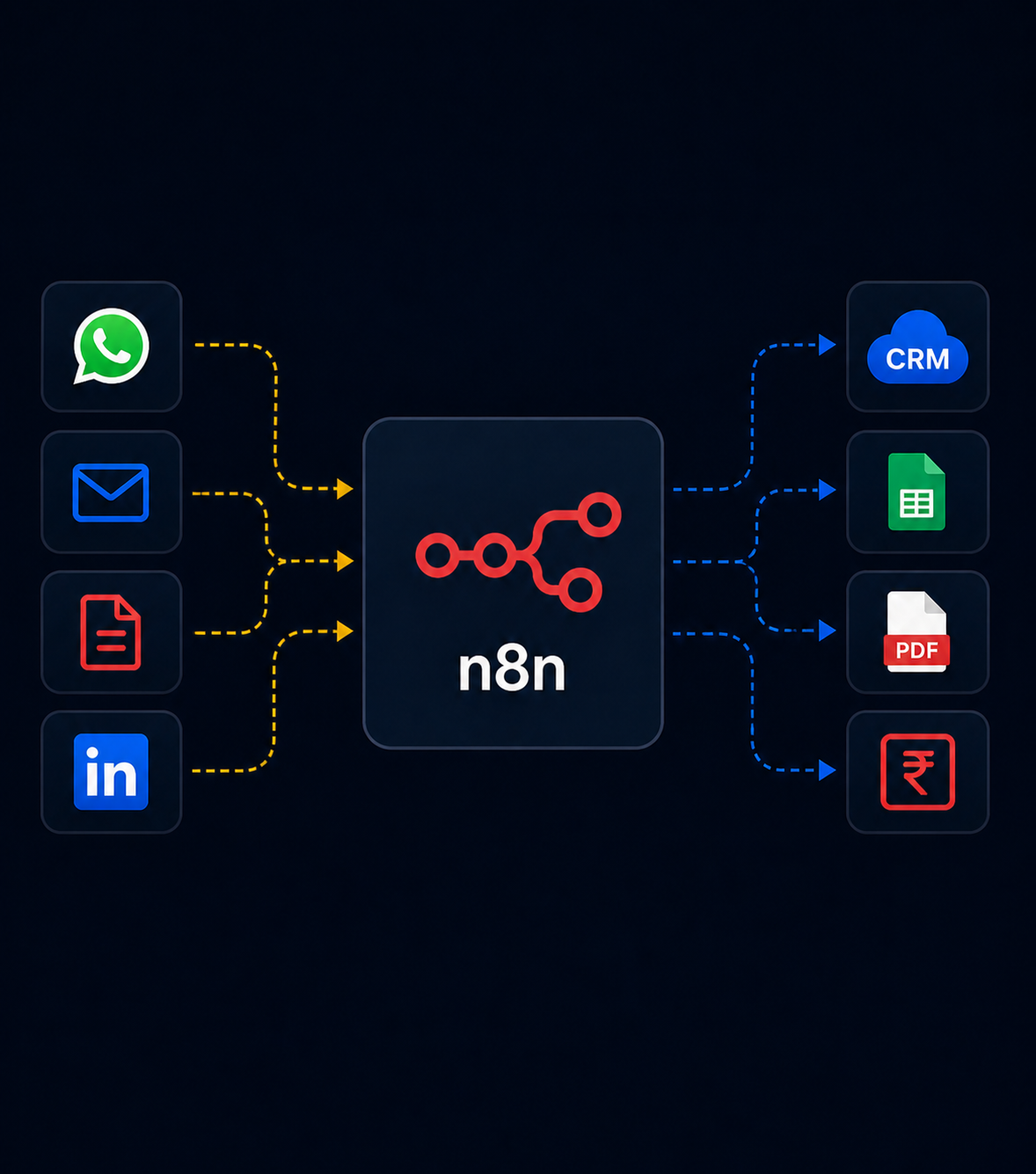
- Updates the CRM with everything
Zero human involvement until the site visit.
Example 2 — Invoice Processing Agent (Manufacturing)
Without the agent: 3 hours per day of an accounts executive reading supplier invoices, verifying quantities against purchase orders, entering data into Tally, and flagging discrepancies.
With the agent:
- Supplier emails invoice (PDF)
- Agent reads the invoice, extracts all fields
- Checks against the purchase order in the ERP
- If everything matches: enters into Tally, schedules payment, confirms to supplier
- If there's a discrepancy: flags for human review with a clear summary of the mismatch
- Logs everything
3 hours reduced to 20 minutes of human review for exceptions only.
Example 3 — Content Publishing Agent (D2C Brand)
Without the agent: Marketing team manually researches topics, writes drafts, gets approvals, schedules posts, formats for each platform, publishes, and tracks performance. 15–20 hours per week.
With the agent:
- Every Monday, agent researches trending topics in the brand's niche
- Drafts 3 blog posts and 15 social media posts
- Sends drafts to the marketing manager for approval (one-click approve/reject)
- Publishes approved content across WordPress, Instagram, LinkedIn, and Twitter on schedule
- Tracks performance and sends a weekly summary
Marketing manager's time: 2 hours per week for review and approvals.
What Agents Cannot Do (Yet)
Be honest about limitations:
- Genuinely novel judgment calls: An agent can handle "process refund under ₹500" reliably. It cannot replace a manager deciding whether to make an exception for a long-standing customer who has a ₹50,000 order dispute.
- Emotional intelligence: A customer who is very upset about a serious issue needs a human. Agents can handle volume; humans handle escalations.
- Creative strategy: "What should our marketing strategy be for the next quarter?" is not an agent task. "Execute the marketing strategy by publishing X pieces of content per week" is.
- Zero-tolerance error tasks: Agents make occasional mistakes. For anything where a single mistake is catastrophic (medical dosing, large financial transactions without review), keep humans in the loop.
What This Costs
The right question isn't "can we afford an AI agent?" It's "how much does NOT having one cost us?"
A lead follow-up agent typically costs ₹1,50,000–2,50,000 to build and ₹5,000–15,000/month to run. If it converts 5 extra leads per month that would have gone cold, and each lead is worth ₹50,000 in revenue — that's ₹2,50,000/month in recovered revenue from a ₹15,000/month investment.
The math is usually simple. The bottleneck is identifying the right process to start with.
We're Monk Media One Tech — AI automation agency, Ahmedabad. We help businesses identify and build the right AI agent for their specific needs.
Book a free 30-minute discovery call: monkmediaone.tech/contact
📞 +91 88668 19349 | hello@monkmediaone.tech