


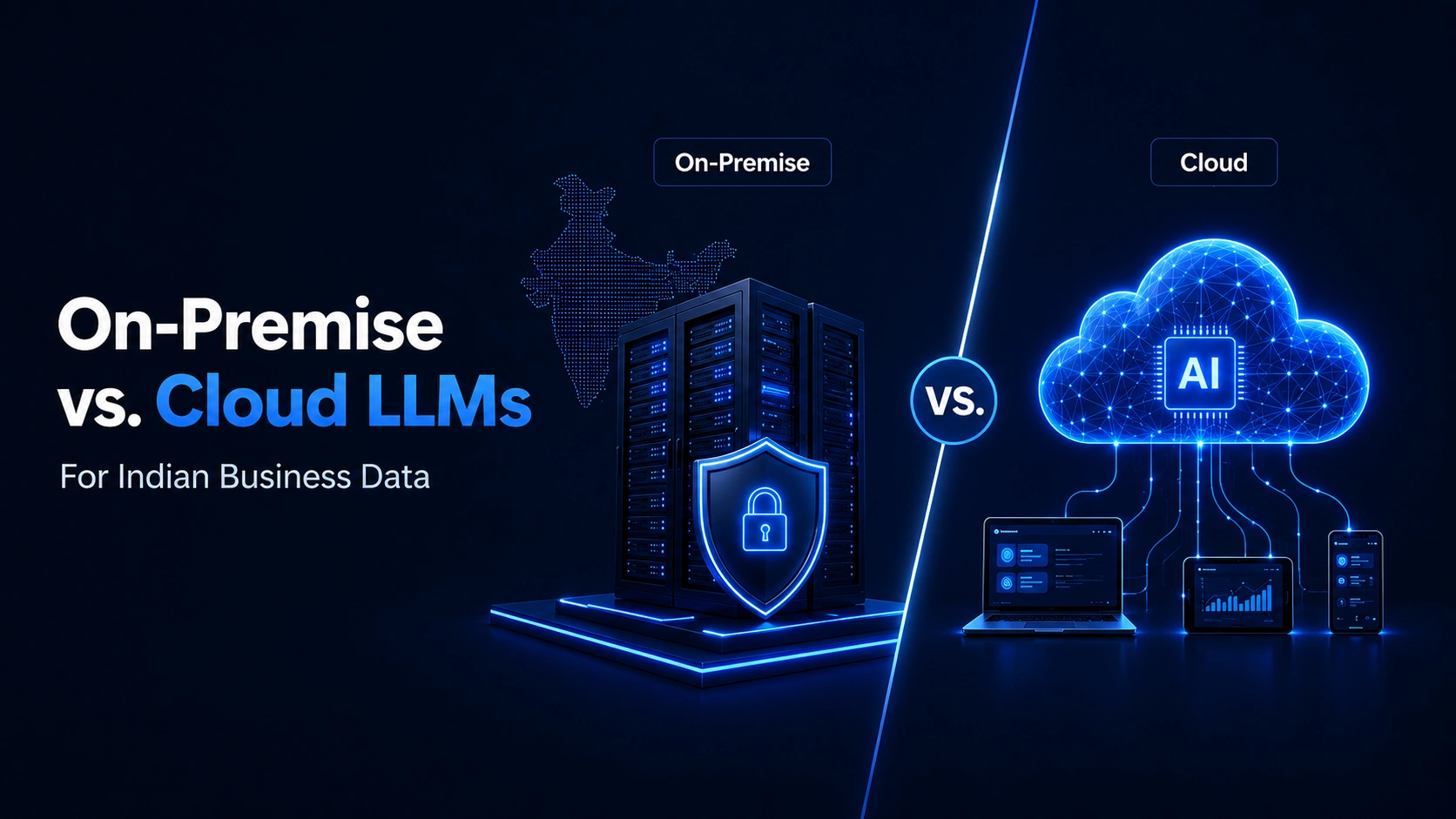
On-Premise vs. Cloud LLMs: Which Is Right for Indian Business Data?
Key Differences
| Factor | Cloud LLM (API-based) | On-Premise LLM |
|---|---|---|
| Setup speed | Fast – days | Slower – requires infrastructure setup |
| Cost structure | Pay-per-use, low upfront | Higher upfront hardware cost, lower marginal cost at scale |
| Data residency | Data typically leaves your infrastructure | Data never leaves your servers |
| Model capability | Access to the most advanced frontier models | Generally 1–2 generations behind frontier cloud models |
| Best for | Most general business use cases | Regulated data, government, healthcare, legal, financial records |
Why Data Sovereignty Matters More in 2026
India’s Digital Personal Data Protection (DPDP) Act places specific obligations around consent, data processing, and cross-border data transfer. Businesses handling sensitive personal data – health records, financial details, government-linked data – increasingly need to evaluate whether routing that data through a third-party cloud AI provider (often hosted outside India) meets their compliance obligations, or whether an on-premise deployment is the safer architecture.
A Practical Middle Ground: Hybrid Deployment
Many businesses don’t need to choose one extreme. A common hybrid approach uses cloud LLMs for general-purpose, non-sensitive tasks (drafting marketing copy, general customer FAQs) while routing anything touching personal or sensitive data through an on-premise or private model, keeping that data fully within their own infrastructure.
Frequently Asked Questions
Are on-premise LLMs as capable as cloud models like GPT-5 or Claude?
Open-source on-premise models have improved significantly and handle many business tasks well, but frontier cloud models generally still lead on the most complex reasoning tasks.
Is on-premise AI more expensive than cloud AI?
Upfront hardware and setup costs are higher, but at high usage volumes over time, on-premise deployment can become more cost-effective since there’s no per-request API fee.
Does the DPDP Act require on-premise AI for all businesses?
No – it depends on the type and sensitivity of data being processed. Businesses should assess their specific data categories and consult on compliance requirements rather than assuming one architecture is universally required.