


AI Agent Security: What Business Owners Must Ask Before Deployment
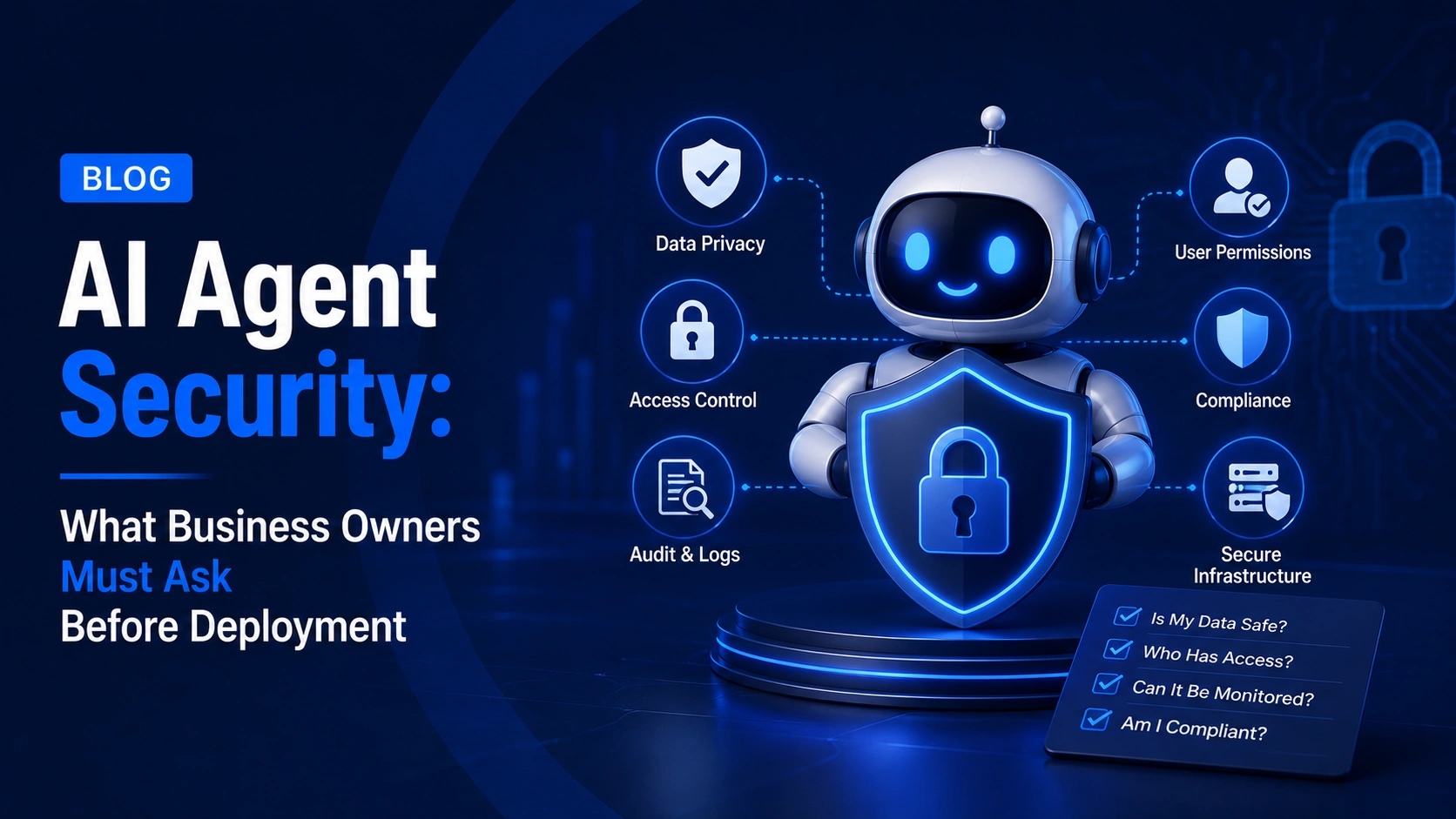
TL;DR: Before deploying an AI agent, confirm how it authenticates to your systems, what actions it’s allowed to take without human approval, how prompt injection attempts are handled, where conversation data is stored, and what audit trail exists for every action the agent takes.
Key Security Questions to Ask Your Vendor
- “What permissions does the agent actually have?” The agent should only have access to the specific systems and actions it needs – not broad admin access “just in case.”
- “What happens if someone tries to manipulate the agent through the chat itself?” This is called prompt injection – a malicious user trying to trick the AI into ignoring its instructions. A secure system has guardrails specifically against this.
- “Which actions require human approval?” High-risk actions (payments, data deletion, external communications) should have an approval checkpoint, not run fully autonomously.
- “Where is conversation and business data stored, and for how long?” Especially relevant for compliance with the DPDP Act.
- “Is there a full audit log of every action the agent has taken?” You should be able to see exactly what the agent did, when, and why.
Common Security Risks in Poorly Built Agents
- Overly broad system permissions (“just give it admin access to make things easier”)
- No guardrails against prompt injection attempts
- No logging, making it impossible to investigate an unexpected action after the fact
- Sensitive data sent to third-party AI providers without a clear data handling agreement
Key takeaways: Treat AI agent security with the same rigor as any other production system with access to business data – least-privilege access, human checkpoints for high-risk actions, and full audit logging are non-negotiable, not nice-to-haves.
Frequently Asked Questions
What is prompt injection, in simple terms?
It’s when someone crafts a message specifically designed to trick an AI agent into ignoring its instructions or revealing information it shouldn’t – similar in spirit to a social engineering attack, but aimed at the AI system.
Should AI agents ever have unrestricted access to payment systems?
No – best practice is to require human approval for any financial transaction above a defined threshold, with the AI handling preparation and routing rather than final execution.
Is it safe to send customer data to third-party AI APIs?
It can be, when the provider has appropriate data handling agreements and the data sent is scoped to what’s necessary – businesses handling highly sensitive data should evaluate on-premise alternatives for those specific workflows.
Deploying AI agents and want a security review first? Talk to Monk Media One Tech →