
What Is Model Context Protocol (MCP) and Why It Matters for Business AI
The Problem MCP Solves
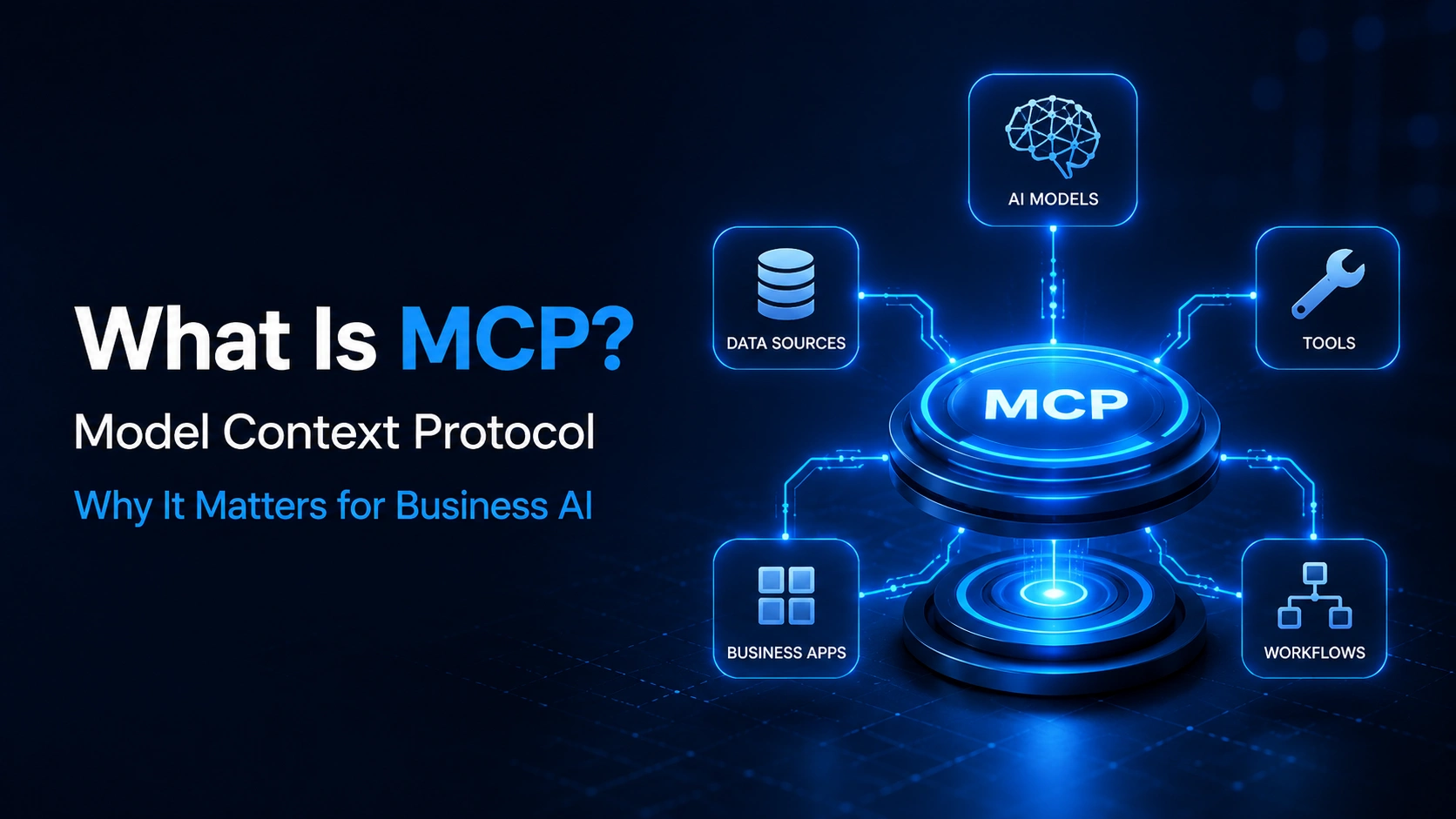
Before standards like MCP, connecting an AI agent to, say, a CRM, a calendar, and an internal database each required a separate, custom-built integration – meaning every new tool added engineering overhead and every AI provider needed its own connector. MCP defines a shared protocol so a tool built once can be used by any MCP-compatible AI system, dramatically cutting integration work.
Why This Matters for Business Automation
- Faster integrations: Connecting an agent to a new business system (Slack, Google Drive, a CRM) becomes a configuration task, not a custom engineering project.
- Vendor flexibility: Businesses aren’t locked into one AI provider’s proprietary integration format.
- Ecosystem growth: A growing library of pre-built MCP connectors means many common business tools already have ready-made integrations.
A Simple Analogy
Before USB, every device needed its own specific cable and port. MCP plays a similar role for AI agents and tools – a standard way for an AI model to discover what tools are available and how to use them, regardless of which underlying model is powering the agent.
Frequently Asked Questions
Do I need to understand MCP to use AI automation?
No – as a business owner you don’t need the technical details, but it’s worth knowing your automation partner is using open, interoperable standards rather than a closed, proprietary system that locks you in.
Which AI providers support MCP?
Support has been expanding rapidly across major AI platforms and developer tools since its introduction – check with your provider or automation agency for current compatibility.
Does MCP replace the need for an orchestration layer?
No – MCP standardizes how agents connect to tools; orchestration still handles the higher-level decision-making about which tools to use and when.