





What Is Function Calling in LLMs? Explained for Business Users
How It Works, Without the Jargon
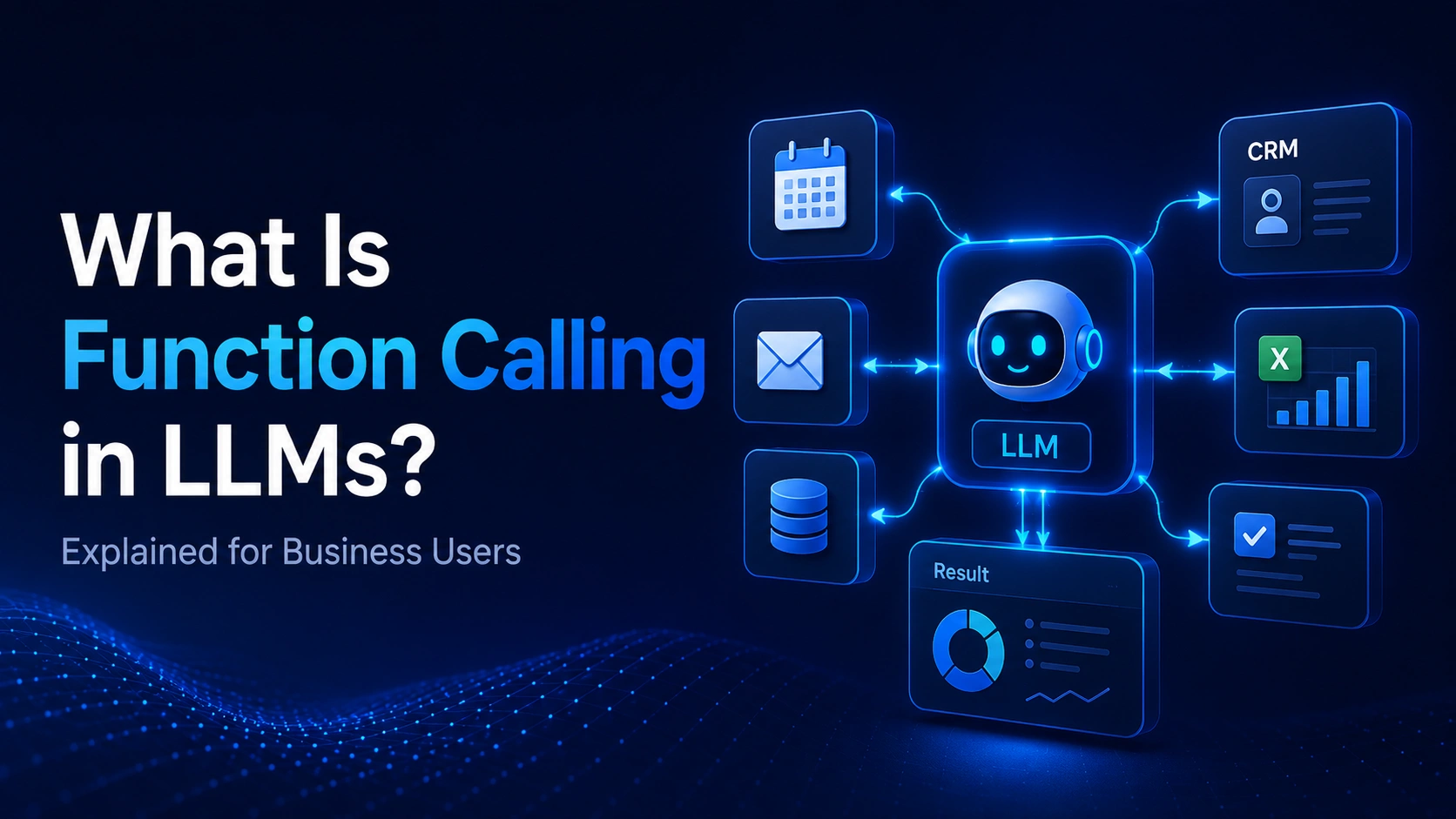
You give the AI model a list of available “functions” it’s allowed to call, each with a description of what it does and what information it needs. When a user’s request matches one of these functions, the model doesn’t try to answer from its own knowledge – it outputs a structured request to call that specific function (for example, “check_order_status” with the order number), your system executes it, and the result is fed back to the model to form its final response.
A Concrete Example
Customer: “Where’s my order #4521?”
The model recognizes this matches a “check_order_status” function, calls it with the order number, receives the real shipping data back from your system, and replies with the actual current status – rather than guessing or making something up.
Why This Matters for Business Automation
- It’s what allows AI agents to check real data instead of hallucinating an answer
- It’s the foundation for connecting AI to CRMs, calendars, payment systems, and internal databases
- It keeps actions structured and controlled – the AI can only call functions you’ve explicitly defined and permitted
Frequently Asked Questions
Is function calling the same as an API integration?
They work together – function calling is how the AI model decides when and how to use an API; the API integration is the actual connection to your business system that executes the action.
Can function calling be restricted for safety?
Yes – you define exactly which functions exist and what parameters they accept, and can require human approval before certain high-risk functions (like processing a refund) actually execute.
Do all AI models support function calling?
Most major current-generation models (GPT, Claude, Gemini, and leading open-source models) support function/tool calling, though implementation details vary by provider.